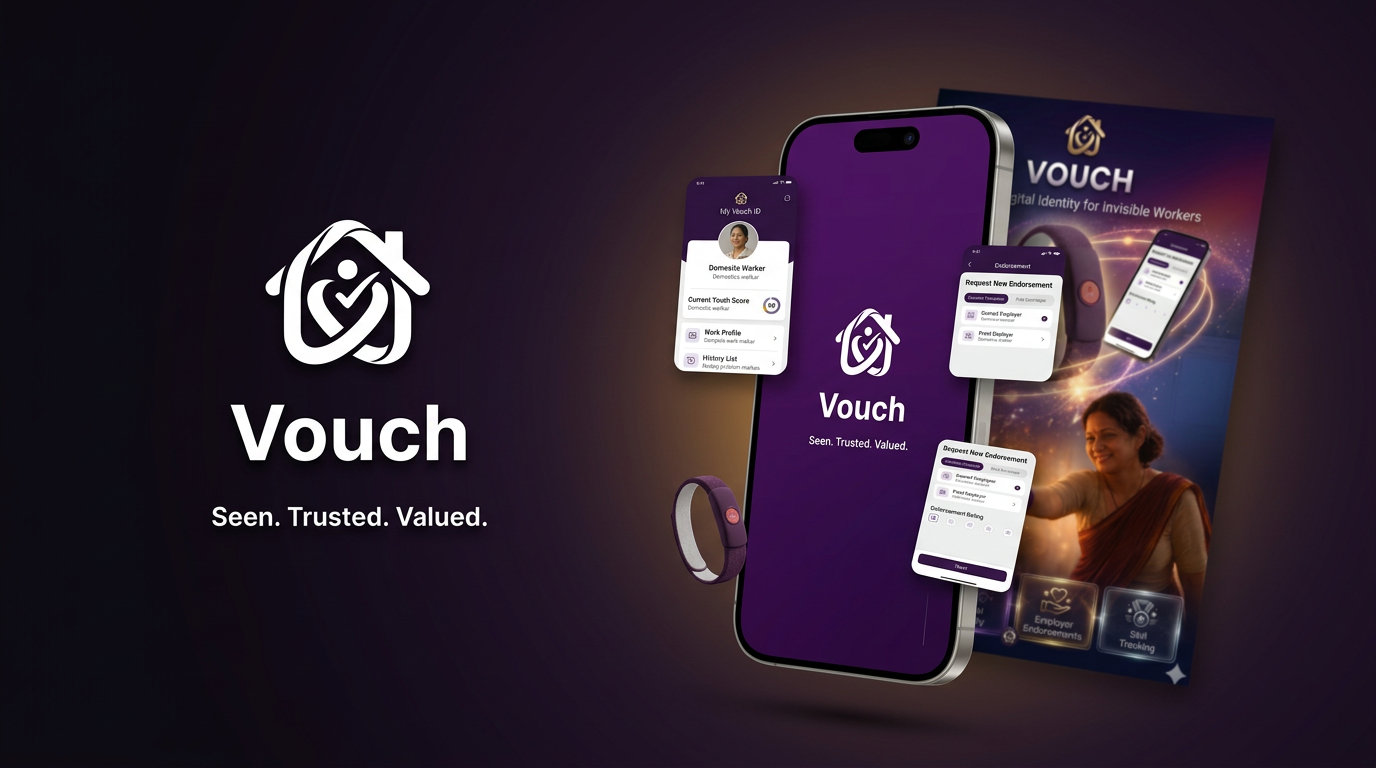
Care work is essential, constant and completely undocumented.
02 · The signal
Field research with caregivers and employers showed trust being rebuilt from scratch in every relationship.
03 · The response
Designed a caregiver-owned identity where work history and community validation travel with the person.
04 · The impact
Invisible labour becomes a verifiable, dignified economic identity — recognised with Best Technical Depth.
00Overview
Who is carrying the invisible load?
VOUCH gives caregivers a way to make their work visible, build trust, and access better opportunities — converting informal, unrecognised care work into a verifiable, dignified identity.
The project was awarded Best Technical Depth at Hackathon 7.0.
01Context
What that experience actually looks like
Caregiving and domestic work is essential yet invisible. It happens inside homes, is arranged through word of mouth, and leaves nothing behind: no history, no reference that travels, no proof of reliability.
No portable record of work history or reliability
Trust is rebuilt from zero with every new relationship
Recognition and opportunity stay locked to word-of-mouth
Caregiver workflow
Add the day-in-the-life workflow or field research artifact
02Tension
Trust exists, but it cannot travel
Caregivers were trusted deeply — by one family at a time. That trust was real, hard-earned and completely non-transferable, so years of reliable work produced no advantage in the next negotiation.
User evidence
Add a caregiver quote or field observation about starting over
03Insight
What field research revealed
Field research with caregivers and the families who employ them showed how trust is actually established, signalled and lost in care relationships — and where the system fails the person doing the work.
Visibility is the foundation of opportunity
Trust must be portable to be valuable
Dignity and safety are design requirements, not extras
Community validation carries more weight than abstract ratings
Journey map
Add the caregiver journey from finding work to being trusted
Insight map
Add the opportunity areas identified from research
04Direction
Where the opportunity was, and what I decided
VOUCH layers identity, work history, trust signals and community validation into a single dignified profile — designed so recognition accrues to the caregiver and travels with them.
What I saw
Every new placement began with the caregiver proving themselves from zero.
What it meant
Trust was being stored by employers, not by the person who earned it.
What I changed
Made the trust profile caregiver-owned and portable across relationships.
Why
If recognition does not travel with the worker, the system keeps re-extracting the same proof.
What happened
Work history becomes an asset the caregiver carries into every new opportunity.
What I saw
Caregivers were wary of platforms that expose their movements and personal details.
What it meant
Visibility without control becomes surveillance rather than recognition.
What I changed
Built privacy and safety guardrails into what visibility means, with community validation as the primary trust signal.
Why
Care work is legible enough through community endorsement; monitoring the worker is not required to establish trust.
What happened
A trust model that increases opportunity without increasing exposure.
05Making
How the service takes shape
The flow moves from identity, to work record, to community validation, to opportunity — with safety built in as a first-class touchpoint rather than a setting.
Service blueprint
Add the blueprint linking caregiver, employer and community touchpoints
Prototype
Add the identity, verification and validation flows
06Proof
Pressure-testing dignity and safety
Trust and visibility flows were checked against caregivers' real safety and dignity needs from field research. The trust model was refined to centre community validation over abstract ratings, and to make work history portable across relationships rather than locked to one employer.
Validation
Add testing sessions, feedback or judging evidence
07Impact
What changed
Award
Best Technical Depth, Hackathon 7.0
Portable
Caregiver-owned trust
Visibility
For invisible work
What changed
Trust stopped belonging to the employer and started belonging to the caregiver. Work history, verification and community validation became one portable record the caregiver carries into every new relationship.
What I learned
The hardest problems are often invisible: nobody described 'no portable trust' — they described starting over.
Visibility is not automatically good; who benefits from it has to be a deliberate design decision.
Community validation carries more weight than abstract ratings in relationships built on care.
What I would do next
Test the verification flow with caregivers who have low digital confidence.
Map the employer side of the service blueprint in equal depth.
Next project
Decoded DFC
Redesigning learning momentum for working professionals